

The Evolution of Toyota Car Design: 1936-2025
 Toyota’s evolution over the past nine decades has taken it from the humble side project of a Japanese textile company to a leading automobile manufacturer. After Kiichiro Toyoda started the car division in 1933, Toyota never stopped adapting its approach to fit changing technologies, customer needs, and environmental issues. At the same time, it has always stuck to making reliable, quality cars. The design journey from the Model AA in 1936 to today’s hybrid and electric vehicles demonstrates how Toyota successfully transformed into the largest automobile manufacturer in the world.
The Foundational Era: 1933-1960
The Toyota Motor Corporation grew out of Toyoda Automatic Loom Works, beginning when Kiichiro Toyoda established a car division of the family business in 1933. The first Toyota car, the Model AA, hit the market in 1936. It had a unique design that balanced streamlined efficiency with passenger comfort, setting the stage for an enduring design approach that put function, durability, and user needs first.
Japanese manufacturing traditions heavily influenced Toyota’s early design principles. With early models, it focused on careful attention to detail, aiming to build dependable vehicles that could handle Japan’s varied road conditions. The Model AA featured clean lines, a smart use of space, and sturdy construction methods that prioritized lasting quality over a flashy appearance. These early years established the core values that would guide Toyota’s design choices for decades.
The International Expansion Phase: 1960-1980
Toyota entered the American automotive market in 1957 with the Toyopet Crown. The automotive company quickly learned lessons about international road conditions, regulations, and consumer preferences, shifting its design strategy to match. Toyota introduced the Corolla in 1965 and the Celica in 1970, gaining new success by balancing Japanese precision with international appeal. The Corolla offered reliable transportation in a style that appealed from Tokyo to Detroit, proving that Japanese design could compete with American and European manufacturing.
In this era of expansion, Toyota created vehicles for climates from hot deserts to harsh winters, adapting layout and styling according to different cultural tastes. At the same time, engineers met evolving safety standards, pollution rules, and performance expectations. Toyota succeeded internationally by maintaining its core values of quality, reliability, and efficiency while adapting to local needs.
The Quality and Reliability Era: 1980-2000
In the 1980s and 1990s, Japanese cars gained a reputation for their durability, efficiency, and longevity. Toyota was central to this perception, and its philosophy influenced car manufacturers worldwide. Leading with quality-focused design, the Toyota Production System emphasized efficient manufacturing through innovative techniques.
Manufacturing relied on lean principles and just-in-time production, cutting waste while boosting quality control. Toyota stressed quality checks throughout manufacturing, ensuring every vehicle met high standards, and design teams worked with production specialists, evaluating designs for long-term reliability and consistent manufacturing.
Importantly, Toyota understood the need to adjust its design philosophy as consumer preferences and expectations changed. However, even as the company met the demand for more sophisticated and visually appealing vehicle designs, it maintained its commitment to efficiency and function, building cars with ample interior space and optimal fuel efficiency.
The Hybrid Pioneer Period: 2000-2010
Toyota released the Prius in 1997. It was the world’s first mass-produced hybrid, combining a gas engine with an electric motor. The Prius hit U.S. showrooms in 2000 and was classified as a Super Ultra-Low Emission Vehicle. The first-generation Prius (2001-2003) produced 97 combined horsepower and achieved an EPA-estimated 41 mpg, proving eco-friendliness doesn’t mean sacrificing performance.
By the end of 2003, Toyota had sold tens of thousands of Prius units globally, demonstrating widespread acceptance of hybrid technology. The second-generation Prius (2004-2009) introduced Toyota’s Hybrid Synergy Drive system and won MotorTrend’s 2004 North American Car of the Year. The Prius achieved remarkable fuel efficiency through regenerative braking, helping to reduce CO2 emissions.
In this era, Toyota’s design teams successfully tackled the complex challenges of fitting hybrid systems while maintaining reliability and practicality, leading to innovations in packaging, weight distribution, and aerodynamics. This success established Toyota as a leader in sustainable car design.
The Modern Design Renaissance: 2010-2020
Toyota continued to find success with the Prius. The third-generation Prius (2010-2015) achieved 50 mpg combined and expanded the lineup to include the Plug-in Hybrid, compact Prius c, and larger Prius v. The fourth-generation Prius (2016-2022) used Toyota’s New Global Architecture (TNGA) platform and achieved EPA ratings of up to 56 combined mpg. Meanwhile, the RAV4 became Toyota’s signature hybrid SUV with huge worldwide sales. Its geometric shapes, sleek lines, sculpted surfaces, and distinctive grille balanced elegance with sportiness.
In this period, Toyota transformed its design emphasis from the purely practical to the visually compelling without sacrificing quality and reliability. Interiors evolved into sleek modern spaces incorporating quality materials and innovative technology, including multifunction touch-screen displays. Toyota also created the GR SPORT Grade, offering bold styling, larger wheels, and unique aerodynamic enhancements across the lineup.
The Electric Future: 2020-Present
In 2020, Toyota refreshed the design of its logo, keeping the iconic overlapping ovals but modernizing it for a digital-first aesthetic. Recent models demonstrate Toyota’s impressive uses of new technology while they continue to prioritize reliability and function. Built on the TNGA-C platform, the fifth-generation Prius (2023-present) offers a 2.0L engine producing up to 196 horsepower in all-wheel-drive configuration. The 2024 Prius achieved recognition as both 2024 North American Car of the Year and 2024 World Car Design of the Year.
The 2026 Sequoia comes equipped with Toyota Safety Sense 2.5, which includes a precollision system with emergency steering assist, lane departure warning, and full-speed range Dynamic Radar Cruise Control. The top trims also feature massaging seats with 10-way power adjustment, controlled via an available 14-inch multimedia touch screen.
Understanding the importance of electric vehicles (EVs) in minimizing carbon emissions, Toyota is investing over $35 billion in its EV and hybrid strategy for future innovation and has significantly expanded its lineup of EVs. GAC Toyota has launched two new energy vehicle platforms, including a battery EV platform optimized for compact and midsize cars. Toyota’s multi-energy architecture supports battery EVs, plug-in hybrids, and range-extended models up to 17.4 feet in length.
The premium bZ7 sedan is set to integrate LiDAR technology and is scheduled for release in China in March 2026. Toyota is also developing partnerships with Xiaomi for AIoT ecosystem integration, Huawei for HarmonyOS 5.0 infotainment systems, and Momenta for intelligent driving systems, demonstrating Toyota’s ongoing commitment to balancing traditional values with new technology.
Experience Toyota’s Legacy at Auburn Toyota
The evolution of Toyota since 1937 shows how a company can adapt to a changing world while sticking to what matters: reliability, quality, and continuous improvement. From the simple Model AA to today’s prize-winning Prius and upcoming EVs, Toyota’s designs have adapted to customer needs, technological breakthroughs, and environmental concerns while never losing sight of the practicalities.
Visit Auburn Toyota to see how nearly 90 years of innovation has created vehicles that fit your needs, whether you’re dealing with Sacramento traffic or exploring Northern California’s mountain roads. Call us at 530 885-8484 to schedule a test-drive today.
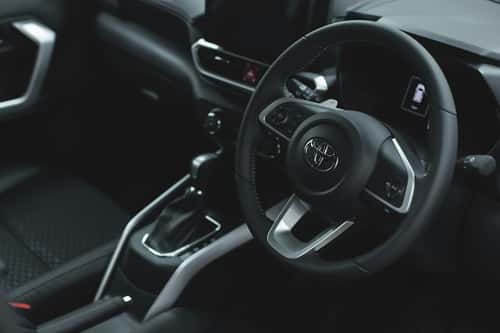
the interior of a car with a steering wheel by Neerob Raihan is licensed with Unsplash License
0 comment(s) so far on The Evolution of Toyota Car Design: 1936-2025